



Determinants of Reproductive Health: Nutrition and Environmental Influences

- Una Grewal, PhD, MPH, Senior Scientist and Associate Scientific Director for Population Health Research
- Elizabeth DeVilbiss, PhD, Staff Scientist
- Shan-Xuan Lim, PhD, Visiting Fellow
- Pricilla Clayton, PhD, Postdoctoral Fellow
The Developmental Origins of Health and Disease (DOHaD) hypothesis recognizes the reproductive period as a critical window for shaping long-term health risks for both mothers and their offspring. Maternal nutrition during pregnancy plays a central role in influencing immediate pregnancy outcomes as well as lifelong health trajectories. Guided by this framework, our work draws on data from the NICHD Fetal Growth Studies, a multi-ethnic cohort of pregnant women, to advance understanding of maternal dietary intake and quality, including the importance of race and ethnicity, in the assessment of fetal growth and pregnancy outcomes.
Our research team has expanded its scope to examine the wide-ranging impacts of extreme weather on reproductive and perinatal health. We developed a first-of-its-kind database that integrates indicators from large-scale pre-conception and pregnancy cohorts across multiple recent DiPHR (Division of Intramural Population Health Research) studies with longitudinal weather data characterized by high geographic and temporal resolution. This integrated resource uniquely positions our work to advance population-level understanding of how extreme weather influences fertility, pregnancy, and childbirth.
Diet during pregnancy: impacts on maternal health and fetal development
Leveraging the rich longitudinal data from the NICHD Fetal Growth Studies, my team has examined how adherence to established healthy dietary patterns, i.e., the Alternate Healthy Eating Index (AHEI), alternate Mediterranean diet (AMED), Healthy Eating Index [HEI], and Dietary Approaches to Stop Hypertension (DASH), relates to pregnancy complications and neonatal outcomes. More recently, we evaluated a novel dietary pattern, the Planetary Health Diet (PHD), introduced by the EAT-Lancet Commission in 2019. The PHD emphasizes plant-based foods with moderate intake of animal-based products and is uniquely informed by considerations of the environmental impact of each food group.
In a study examining adherence to these dietary patterns and gestational weight gain, we found that greater adherence to several healthy diets, including DASH, AMED, HEI, and AHEI, was associated with lower odds of inadequate gestational weight gain. In a second study, we assessed whether high peri-conceptional and early pregnancy adherence to the PHD was associated with fetal growth patterns, using longitudinal 2D and 3D fetal biometric measures from the NICHD Fetal Growth Studies and the Fetal 3D Study. Among this low-risk cohort, higher adherence to the PHD was associated with greater fetal adiposity and reduced lean tissue, reflected in larger fractional arm volumes in the second trimester and greater fetal weight and abdominal measures in the third trimester.
Extreme weather and reproductive health
The health consequences of extreme weather are increasingly recognized, yet important gaps remain in understanding its effects on fertility, pregnancy, and childbirth. To address this gap, we developed a first-of-its-kind database that integrates data from large-scale pre-conception and pregnancy cohorts across multiple recent DiPHR studies with longitudinal weather indicators characterized by fine geographic and temporal resolution. This resource uniquely enables population-level investigation of how extreme weather influences reproductive and perinatal health.
Using these data, our team examined associations between exposure to extreme hot and cold ambient temperatures during pregnancy and preterm birth. We found that both chronic heat and chronic cold exposure were associated with an increased risk of early preterm birth (gestational age of under 34 weeks), with the risk rising monotonically as the proportion of days with extreme temperature exposure increased (Figure 1). These findings have important implications for clinical care and public health, particularly as climate projections indicate that extreme temperatures will become more frequent and severe. As a result, a growing number of pregnancies may face elevated risk of early delivery and subsequent adverse health outcomes in offspring.
Figure 1. Exposure to varying chronic heat and cold thresholds and preterm birth rate
GA: gestational age
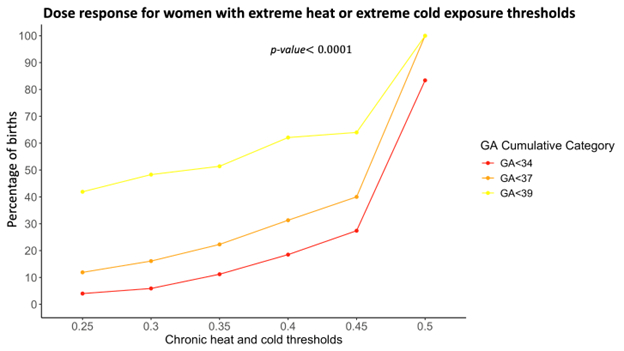
Figure 1. Exposure to varying chronic heat and cold thresholds and preterm birth rate
GA: gestational age
Publications
- Maternal adherence to healthy dietary patterns during pregnancy and gestational weight gain. Nutrients 2025 17(16):2707
- Adherence to the Planetary Health Diet Index and fetal body composition. JAMA Netw Open 2025 8(12):e2544153
Collaborators
- Zhen Chen, PhD, Biostatistics and Bioinformatics Branch, DiPHR, NICHD, Bethesda, MD
- Katherine Grantz, MD, MS, Epidemiology Branch, DiPHR, NICHD, Bethesda, MD
- Shyamal Peddada, PhD, Biostatistics and Computational Biology Branch, NIEHS, Research Triangle Park, NC
- Neil Perkins, PhD, Biostatistics and Bioinformatics Branch, DiPHR, NICHD, Bethesda, MD
- Roger Newman, MD, Medical University of South Carolina, Charleston, SC
- Siddarth Rawat, PhD, Biostatistics and Computational Biology Branch, NIEHS, Durham, NC
- Cuilin Zhang, MD, PhD, MPH, National University of Singapore, Singapore
Contact
For more information, email grewalja@mail.nih.gov or visit https://www.nichd.nih.gov/about/profiles/leadership/diphr_dir_director.